

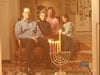
The primary observance of Chanukah is lighting the menorah. For eight days running, we kindle the menorah's flames, adding a new light each evening. Each day has a purpose, so each of the menorah's lights must have a distinct lesson. Let us explore eight lessons we can learn from these little lights.
-
A room full of darkness is drastically changed by even a very small flame. A little light drives out a lot of darkness. Darkness is the absence of light; so any light means the end of darkness. By the same token, evil exists when we are apathetic and don't make any effort to change the situation in our homes and in society, between us and G‑d and between us and our fellow humans. Any effort, any change, any illumination we create goes a very long way. We should never allow the seeming smallness of our contribution to prevent us from making it and appreciating its importance.
-
An oil lamp or candle is made up of three elements: the fuel (oil or wax), the wick, and the flame. The wick corresponds to our body, the flame represents the enthusiasm of the G‑dly spark we all carry within, and the mitzvot (precepts) of the Torah are the oil that feeds our flame. Spiritual enthusiasm—the flame—can consume the wick and destroy it while creating only a brief and smoky light. We need to allow the body to burn with the soul's light, but not be consumed by it. Mitzvot enable us to feed the enthusiasm of our spirituality in a way that illuminates our surroundings but does not immolate our self. The goal of life is not to escape it, but to make it holy and meaningful, which means that our every physical activity should express the light of the divine.
-
Each night of Chanukah we add a light. This teaches us that we must avoid self-satisfaction in spiritual matters. If we are given another day—it is to accomplish something positive we have not yet achieved.
-
We kindle the Chanukah lights by a door or a window—exits to our home. It is not enough to light up our own lives; we must share what we know to be good with others. Spiritual selfishness is the worst kind of all.
-
The laws of Chanukah mandate that each flame should use only one wick, not more. When we are engaged in a mitzvah or other holy task we must stay focused on the moment and the task at hand. Other moments and deeds will come; but true accomplishment is achieved only when our entirety is focused on the instant in which we are living.
-
We kindle the Chanukah lights only when it becomes dark in our spot of the globe. We must devote our efforts to the particular darkness we see in our lives and communities. If there is a darkness in our "place," there is where we must bring our light.
-
The lights of Chanukah speak of the need to never allow the majority's apathy or opinions to sway us when we know that which G‑d desires us to do—as articulated in the Torah. The vast majority of Jews were resigned to the Hellenizing of Israel and the degradation of the Temple. Just one family—the Hasmoneans—refused to accept this, and by their seemingly futile gesture of rebellion ignited the latent sparks of G‑dliness and zeal in their fellow Jews. In the parlance of the tune played by the band of the British Royal Army at Yorktown in 1781, the "World turned upside down."
-
The lights of Chanukah reflect a miracle that happened with the menorah in our Holy Temple (Beit Hamikdash) in Jerusalem. They are the continuation of those lights from the past and a promise for the future. They glow with the promise that G‑d will not be absent from Home forever and that those Temple lights will once again be kindled in a Third and Eternal Temple, standing firm on its Mount, in a redeemed, happy and united World. May G‑d help that we soon see this with our own eyes.




Maybe I don't understand . To quote "Spiritual selfishness is the worst kind of all." I don't think the Rebbe meant to say this in this society without an explanation as to what is Spirtual Selfishness / Certainly, even before Nazi Germany, Jews lived in Gettos in Europe.
The way things were communicated was through the Rabbi of the Community and then to them. The Jewish Community was set apart from the general population. All of this lead to the Nazi claiming a right to kill Jews and blame them as scapegoats.
The problem is a Jew can not share his spirtuality with those who are not Jews.
The idea of putting the menorah at the door is death in this community. My neighbors don't welcome Jews- they put up with them.
I wonder if you still feel this way considering many are embracing judaism and all things "jewish."
I have been following judaism for 14 going on 15 years now, It was a spiritual pull toward what made sense to me. I never understood why, yet looking back saw times where HaShem used jewish people to interact with me. I started attending temple 2 years ago and hope to make my my formal conversion in the next year. As well as my husband who has fell in love with judaism and what it teaches and offers.
Incidentally, I found out I have jewish connections in my dna, I just wasn't raised in a jewish household.
Please, Do not discount the light shining and being shown to those of us who didn't know they are part of Israel until now. We deserve to know and understand our role in Hashem's plan for HIS people. Many dispersed and hid amongst other people to disguise their identity. All must be fulfilled for a Mashiach to return.
This is true more now. I am not Jewish but choose to follow Judaism where no one else wants to understand principles mentioned in the article. Whether we individually choose to or not, Hashem's way will prevail.